English
 Español

THE COUNCIL OF THE EUROPEAN UNION published the following yesterday:
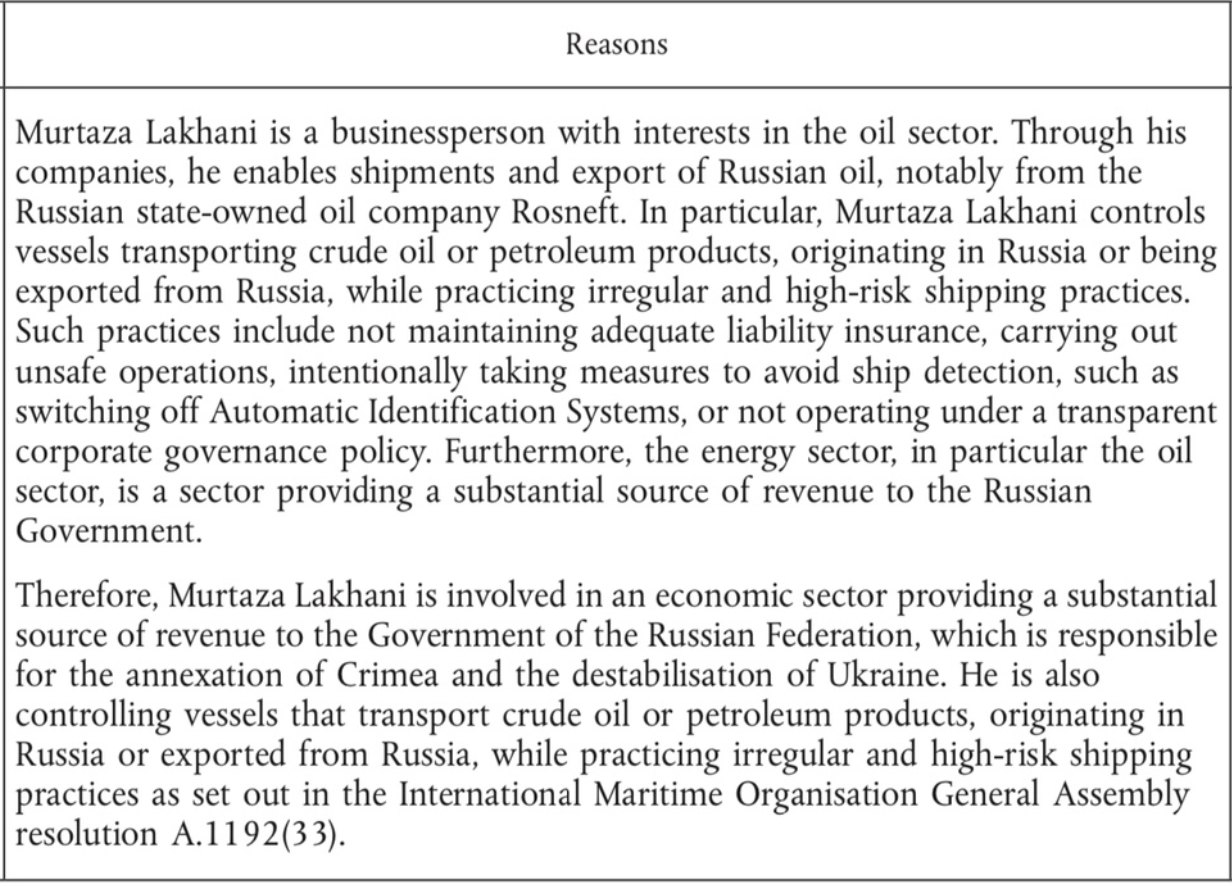
"Murtaza Lakhani is a businessperson with interests in the oil sector. Through his companies, he enables shipments and export of Russian oil, notably from the Russian state-owned oil company Rosneft. In particular, Murtaza Lakhani controls vessels transporting crude oil or petroleum products, originating in Russia or being exported from Russia, while practicing irregular and high-risk shipping practices. Such practices include not maintaining adequate liability insurance, carrying out unsafe operations, intentionally taking measures to avoid ship detection, such as switching off Automatic Identification Systems, or not operating under a transparent corporate governance policy. Furthermore, the energy sector, in particular the oil sector, is a sector providing a substantial source of revenue to the Russian Government.
Therefore, Murtaza Lakhani is involved in an economic sector providing a substantial source of revenue to the Government of the Russian Federation, which is responsible for the annexation of Crimea and the destabilisation of Ukraine. He is also controlling vessels that transport crude oil or petroleum products, originating in Russia or exported from Russia, while practicing irregular and high-risk shipping practices as set out in the International Maritime Organisation General Assembly resolution A.1192(33)."
Compare the findings of the EU's Council about Lakhani's Russian operations described above with this site's research posted in early 2021:
Hence, vessels that used to be owned / controlled by Lakhani, are still involved in Venezuela with Rosneft.
These vessels journeys to Venezuela are shrouded by AIS switch offs, and are lifting crude that used to be traded by Rosneft Trading S.A.
One of the vessels, Mirame, loaded crude produced by PetroMonagas (Rosneft / PDVSA JV).
The jurisdictions of new ownership structure behind Mirame & Kitakaze (Seychelles, Belize, Djibouti) are notoriously opaque, i.e. perfect to hide UBOs and avoid existing sanctions by U.S. Treasury.